Adding seismic isolation usually increases construction expenditure. Yet a building serves for many years, and earthquakes can bring repair costs, closure and interruption of its functions. For a hospital, the long-term accounts deserve particular attention.
List the potential future losses first
The paper takes a life-cycle perspective, combining initial construction cost with earthquake losses during service. These include structural and nonstructural damage, property losses, relocation and interrupted income. Discounting places costs incurred at different times on a common basis.
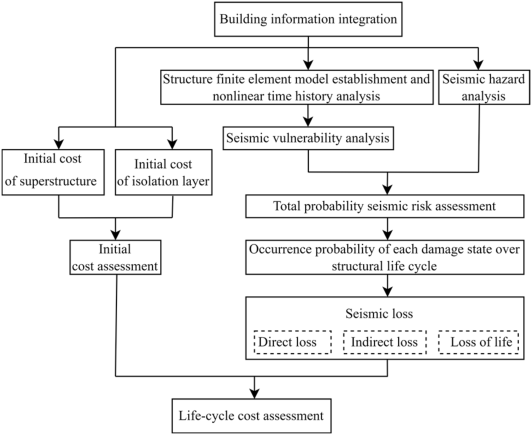
The key is connecting earthquake occurrence, building damage probability and the consequences of damage. Response surfaces improve the efficiency of fragility analysis, after which response and damage under different earthquake intensities become expected long-term losses. The flowchart shows the route from mechanical analysis to economic assessment.
Expected loss is a probability-weighted total across many possible earthquake scenarios. Frequent small events and rare severe events each receive their corresponding weight. Discounting converts future expenditure to the same reference time, allowing today's construction cost and repairs many years later to be compared. Together these steps turn analysis of a single earthquake into economic assessment over a service life.
What changes in the hospital example?
For an eight-storey reinforced-concrete hospital, the study compares isolated and non-isolated schemes over a 50-year service life. In this example, isolation increases initial cost by about 3.69%, but greatly reduces expected earthquake losses. The calculated life-cycle cost is about 32.42% of that of the non-isolated scheme.
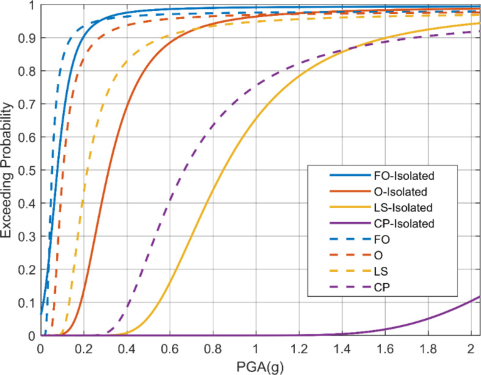
These values depend on the paper's site, cost and loss assumptions. The mechanism is straightforward: isolation reduces the probabilities of several damage states, which in turn determine expected future repair and functional-interruption costs. For a hospital, consequences associated with service and income interruption are important entries in the accounts.
Expected earthquake loss for the isolated scheme is about 1.85% of the non-isolated value, whereas life-cycle cost is about 32.42%. These ratios refer to different accounts. The first concerns earthquake losses; the second also includes construction and other costs. Always identify what is being compared. Hospital closure also matters beyond repairing beams and columns: interruption losses enter the model through damage levels and recovery, influencing the long-term assessment of isolation investment.
Compare schemes over the building's whole life
The same initial investment has different long-term value for different building functions, seismic hazards and service lives. Life-cycle assessment provides a common framework for these differences.
The study makes the economic discussion of isolation more complete. Designers can state what is spent now, which future losses are expected to decrease, and what assumptions support the conclusion. Seismic performance becomes connected to the building's ability to provide service over time.
In practice, variable economic assumptions—service life, discounting and estimates of different interruption losses—can be listed separately and varied to test whether scheme rankings remain stable. The mechanical model estimates possible damage; the economic model explains what that damage means for a particular use. Explicitly connecting the assumptions lets designers, builders and facility managers discuss isolation on the same terms.