Airport control towers are tall and slender, and often bend noticeably in earthquakes. Viscous dampers need relative movement between their ends to dissipate energy effectively. If movement at the installation point is small, their potential is underused. Can that small movement be amplified within limited space?
Add a frame that magnifies damper motion
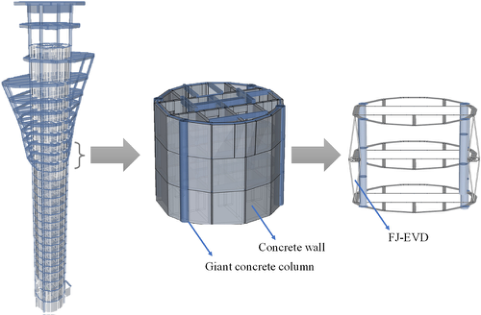
The paper investigates a frame-jack-enhanced viscous damper, or FJ-EVD. Its geometry converts local tower deformation into relative motion better suited to driving a damper. Think of it as a motion converter: deformation of the outer frame produces a larger stroke in the internal damper.
This conversion is specifically useful for towers dominated by bending. Installation must fit the tower's space and multi-storey arrangement so structural movement reaches the dissipative element smoothly. The original figure places the tower and devices together to show their relationship.
Because dissipation depends on relative terminal motion, a damper at one location may contribute little even when the tower top moves substantially. The FJ-EVD frame changes the displacement-transfer ratio, converting small external deformation into more noticeable damper motion. The mechanism also transmits forces to its connections, so geometry and damping parameters must be designed together to coordinate energy dissipation with structural load paths.
Tune amplification together with the tower
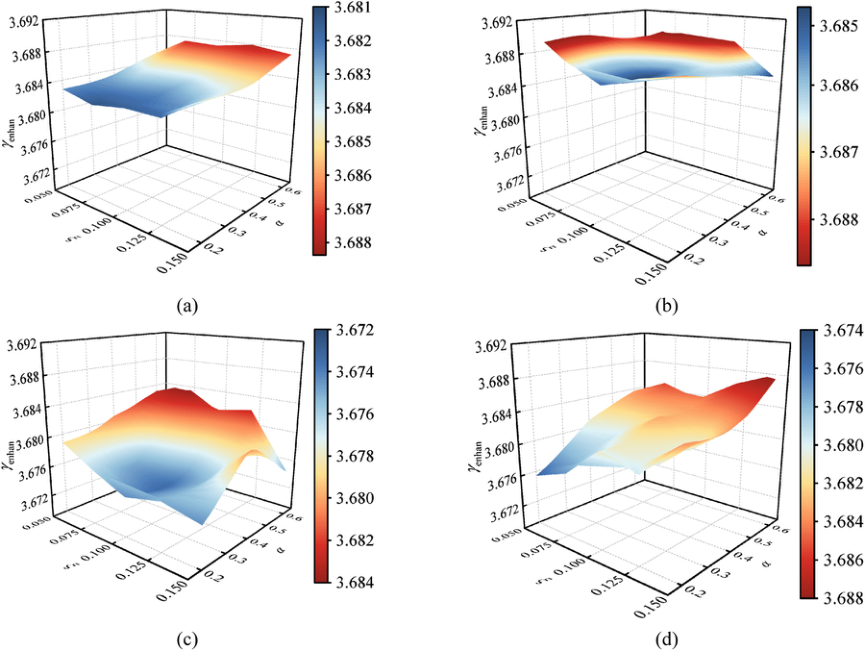
Nonlinear time-history analyses vary device parameters and examine motions with different frequency characteristics, including far-field and pulse-type records. Comparisons include an optimized conventional damping scheme to identify the control differences produced by motion amplification.
A response surface is a tuning map. Moving along different axes changes design parameters, while surface height represents structural response. It exposes their joint effects rather than encouraging each parameter to be increased or decreased in isolation.
Different records test how the device works under different rhythms. Far-field records may contain more distributed back-and-forth vibration, while pulse-type motions deliver a pronounced movement pulse. Their interaction with the tower's own frequencies determines response. Multiple inputs reveal whether one parameter set mainly benefits a particular scenario and whether displacement and force measures improve together, extending tuning beyond a single trial calculation.
Make structural deformation work for the device
The examples show that a well-designed FJ-EVD can improve tower vibration control with a compact arrangement. Its effectiveness comes from matching structure, mechanism and damper: the tower supplies motion, the mechanism modifies it, and the damper dissipates its energy.
The study illustrates another approach to vibration control. Besides selecting damper size, designers can ask how existing structural deformation can drive dissipative elements more effectively. This is attractive for slender structures with limited space and distinctive deformation patterns.
Response surfaces also explain why combinations matter. Increasing one parameter may improve one measure while barely changing another. Following the surface reveals trends across combinations. By comparing device mechanism, installation location and seismic input within one system, the paper offers a clear design approach: understand where and how the tower mainly deforms, then match the motion-conversion mechanism to those characteristics.