Common descriptions of earthquake motion include peak acceleration, peak velocity and peak displacement. Like photographs from different viewpoints, each emphasizes a different feature. For a fault-crossing tunnel, relative movement of the surrounding ground directly pulls on the lining. Which measures best correspond to the tunnel’s deformation demand?
First, expose the tunnel model to relative movement
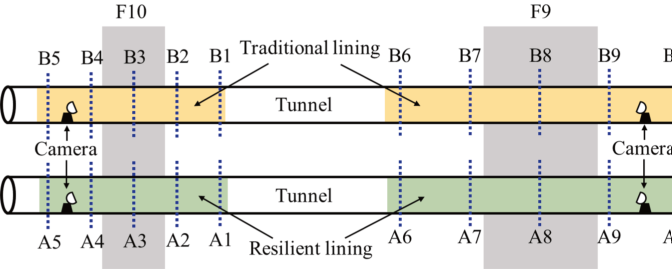
Through shaking-table tests, the paper compares conventional and resilient linings in fault-crossing tunnel models and examines relationships between several ground-motion intensity measures and strain. Sensors distributed along the models record both the input and structural response.
A buried tunnel is surrounded by ground, and its local deformation is closely related to differences in motion along its alignment. Two locations translating together and two locations moving apart can impose different tensile, compressive and shear demands on the lining, even when some absolute-motion measures are similar.
Imagine a long flexible hose buried in soil. When all the soil moves together, the hose mostly translates with it. When neighbouring soil moves out of step, the hose is stretched, compressed or sheared more strongly. Near a fault, vibration and nonuniform displacement coexist, and an absolute input peak captures only part of the picture. The paper therefore compares several intensity measures with measured strains to find quantities that better describe this interaction.
Looking at displacement and velocity together
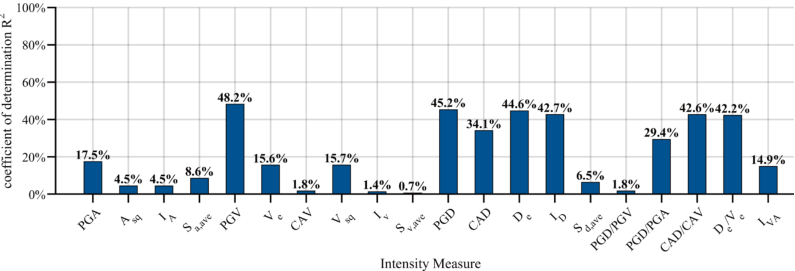
The study finds that features related to relative deformation are important for explaining tunnel strain. The ratio of peak ground displacement to peak ground velocity, PGD/PGV, provides a quantity related to the motion’s time scale and helps distinguish the deformation effects of different inputs.
Within the paper’s test data, combining this ratio with other displacement-related measures improves their association with structural strain. The original figure compares correlations for several measures. The key is to identify which descriptions more closely follow the measured response and whether conventional and resilient linings show similar patterns.
PGD has units of length, while PGV has units of length divided by time, so PGD/PGV has the dimension of time. The ratio links displacement amplitude and velocity level, providing information about the scale of the motion. Combining it with displacement-related measures seeks to describe both motion characteristics and amplitude. The correlation comparisons show how these combinations perform: descriptions more closely aligned with the deformation mechanism can better connect different input cases to lining strain.
Matching the intensity measure to what matters for the structure
Resilience measures change response amplitudes, while the main relationships between intensity measures and response retain common features in the tests. Identifying useful ground-motion characteristics can therefore support more targeted comparisons between lining schemes.
The study turns “How strong is the earthquake?” into the more specific question “Which motion features are most likely to deform the tunnel?” Incorporating relative movement and time scale into record selection, testing and assessment helps connect the input description with actual structural demand.
Comparing conventional and resilient linings in the same experiments addresses two levels of the problem: how structural measures change response levels, and whether the relationship between input features and response changes with structural form. Shared associations across the two linings provide evidence for tunnel-oriented descriptions of seismic input. These features can then inform the selection of test motions or performance-assessment cases, helping the chosen inputs cover the deformation demands a tunnel may experience.